Geomechanics.io

  • Free Tools
Sign UpLog In

    Geomechanics.io

    Geomechanics, Streamlined.

    © 2026 Geomechanics.io. All rights reserved.

    Geomechanics.io

    CMRR-ioGEODB-ioHYDROGEO-ioQCDB-ioFree Tools & CalculatorsBlogLatest Industry News

    Industries

    MiningConstructionTunnelling

    Company

    Terms of UsePrivacy PolicyLinkedIn
    Projects

    Stevens backs Kishorn dry dock expansion: production and plant lessons for engineers

    September 3, 2026|

    Reviewed by Joe Ashwell

    Stevens backs Kishorn dry dock expansion: production and plant lessons for engineers

    First reported on The Construction Index

    30 Second Briefing

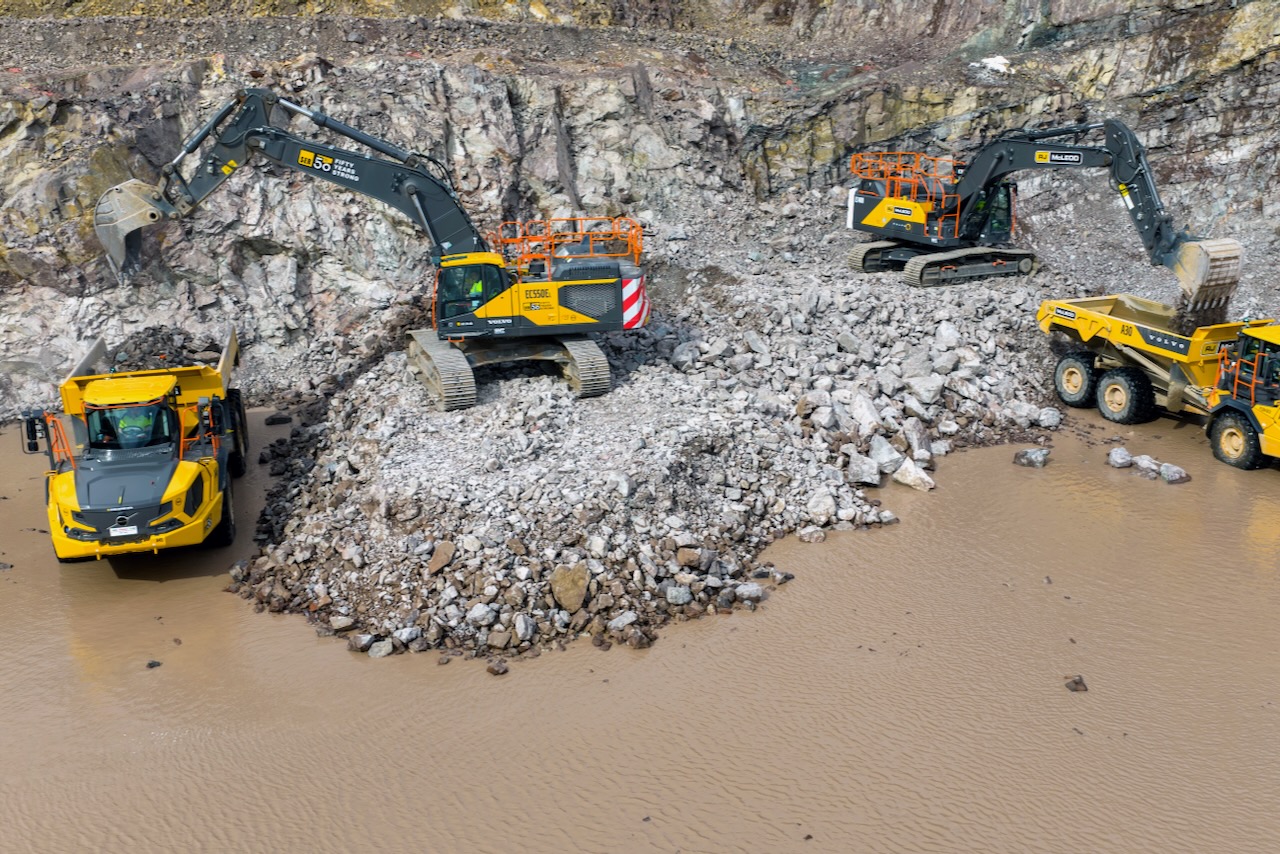
    Stevens Equipment Rental has deployed more than 20 heavy machines to RJ McLeod’s expansion of Kishorn Port’s circular dry dock, which currently accommodates 160m-long vessels at 13.8m below high tide and is being extended by 100m with nine hectares of reclaimed laydown land. Over 450,000m³ of highly abrasive Torridonian sandstone is being drilled, blasted and processed on site, with a deliberately wide blast pattern producing both rock armour boulders and segregated feed for mobile crushing. A mixed Volvo and Caterpillar fleet – including A45/A30 haulers, EC550 excavators and D7/D6 dozers – is being run as a tightly balanced system, supported by on-site parts, fluids and a resident engineer to maintain continuous production.

    Technical Brief

    • Torridonian sandstone abrasivity is driving accelerated wear on ground-engaging tools and haulage components.
    • Existing internal road networks had to be re-routed before bulk drilling and blasting commenced.
    • Wide-spaced blast pattern is deliberately tuned to generate intact rock armour plus crusher feed in one pass.
    • On-face heavy excavators load articulated haulers directly from blasted rock, minimising double-handling cycles.
    • A hammer-equipped excavator is dedicated to breaking oversize blocks ahead of the mobile crusher.
    • Wheel loaders and dozers undertake continuous feed, placement and trimming as dock walls and laydown platforms form.
    • On-site parts, fluids and a resident Stevens engineer underpin high plant availability in the remote Highlands location.

    Our Take

    Stevens Equipment Rental’s role at Kishorn sits alongside its recent trials of hydrogen retrofit systems on Volvo plant, suggesting future dry dock campaigns in the West Highlands could become a test bed for lower‑emission heavy equipment in marine infrastructure work.

    In our infrastructure coverage, few UK port or dry dock projects feature reclaimed laydown areas on the scale of the 9 ha at Kishorn, which is likely to be attractive for large modular fabrication or decommissioning contracts beyond the Ninian Central precedent.

    Recent pieces on Stevens’ adoption of Cat 972 loaders with collision warning and the UK’s first Cat 980 with automatic emergency braking indicate that RJ McLeod is gaining access to a rental fleet with above‑average safety technology for a remote, high‑risk coastal construction environment.

    Geotechnical Software for Modern Teams

    Centralise site data, logs, and lab results with GEODB-io, CMRR-io, and HYDROGEO-io.

    No credit card required.

    • Save and export unlimited calculations
    • Advanced data visualisation
    • Generate professional PDF reports
    • Cloud storage for all your projects

    Prepared by collating external sources, AI-assisted tools, and Geomechanics.io’s proprietary mining database, then reviewed for technical accuracy & edited by our geotechnical team.

    Related Articles

    Strabag’s Pfaffensteig Tunnel contract: design and delivery notes for rail engineers
    Infrastructure
    4 months ago

    Strabag’s Pfaffensteig Tunnel contract: design and delivery notes for rail engineers

    Strabag and Group company Züblin have secured the design-and-build structural works for the ABS Gäubahn Nord/Pfaffensteig Tunnel in south-west Germany, centred on an 11km twin-bore rail tunnel linking Stuttgart Airport station directly to the Gäubahn line towards Switzerland. About 9.8km will be driven by two TBMs, with conventional tunnelling for the A8 motorway undercrossing and airport connection, plus a 240m cut-and-cover section, retaining structures, railway underpasses and a grade-separated crossing. A 3km surface section will be upgraded and partially realigned for 200km/h operation, delivered under an integrated project delivery model with Ed. Züblin, Wayss & Freytag and Strabag AG sharing tunnelling, structural and earthworks packages.

    National Grid TBM under the Thames: tunnelling design and risk notes for engineers
    Infrastructure
    6 months ago

    National Grid TBM under the Thames: tunnelling design and risk notes for engineers

    A 271.5‑tonne Herrenknecht Mixshield TBM, Caroline, has started driving a 2.2km electricity cable tunnel with a 4m internal diameter beneath the River Thames in Essex for National Grid’s Grain to Tilbury project, delivered by the Ferrovial BEMO joint venture. The drive will pass through variable Thames estuary ground conditions between 35m‑deep launch and reception shafts of 15m and 12m diameter, with tunnelling continuing into 2026 and overall scheme completion targeted for 2029. The new tunnel will replace the 1969 Thames Cable Tunnel and carry new high‑voltage circuits between Grain and Tilbury substations.

    Panama Canal Mixshield undercrossing: design and tunnelling lessons for engineers
    Infrastructure
    7 months ago

    Panama Canal Mixshield undercrossing: design and tunnelling lessons for engineers

    A 13.46m diameter Herrenknecht Mixshield TBM has broken through into the future Balboa station on Panama Metro Line 3 after completing the first-ever TBM undercrossing of the Panama Canal at depths exceeding 60m below sea level. The 5,600kW, 26,616kNm machine, fitted with an accessible cutterhead and more than 4,500 sensors linked via the Herrenknecht.Connected platform, has achieved peak advance of 150 segment rings (about 300m) per month through mixed sandstone, tuff, breccias and basalt. Around 1.5km of the 4.5km twin-track tunnel remains to final breakthrough.

    Related Industries & Products

    Construction

    Quality control software for construction companies with material testing, batch tracking, and compliance management.

    Mining

    Geotechnical software solutions for mining operations including CMRR analysis, hydrogeological testing, and data management.

    QCDB-io

    Comprehensive quality control database for manufacturing, tunnelling, and civil construction with UCS testing, PSD analysis, and grout mix design management.

    AllGeotechnicalInfrastructureHazardsEnvironmental