South32 Hermosa Arizona capex blowout: project economics and schedule for mine planners
Reviewed by Joe Ashwell
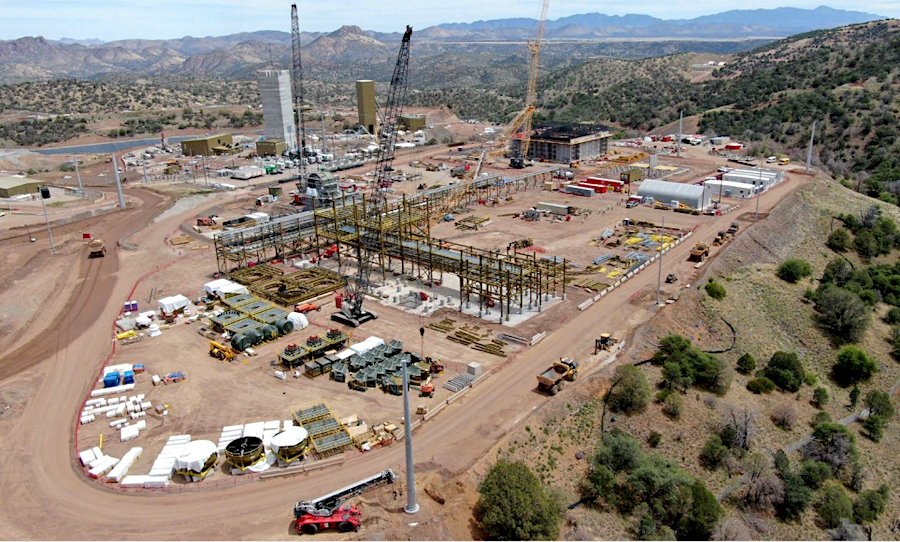
First reported on MINING.com
30 Second Briefing
South32 has lifted first-stage capex for the Taylor deposit at its Hermosa zinc-silver project in Arizona by over 50% to $3.3 billion, pushed first production to H2 FY2028, and now expects unit operating costs of $100/t versus $86/t, citing contractor underperformance, shaft construction issues and US tariffs. Full production is delayed to FY2031, sustaining capital rises to about $50 million a year, and the project IRR drops from 22% to ~19%, prompting a 5.4% share price fall and analyst downgrades to Hermosa’s investment case. Offsetting this, Taylor’s ore reserves are up 52%, mineral resources 10%, and mine life extended from 28 to roughly 33 years, with the adjacent Peake copper deposit’s resources up 32%.
Technical Brief
- Construction bottlenecks are concentrated on a critical ventilation shaft, where productivity measures only partially offset contractor underperformance.
- CEO Graham Kerr directly linked delays to slower-than-expected productivity and scope changes in underground development.
- External shocks cited include war in Ukraine, recent Middle East conflict and US tariffs impacting supply chains.
- RBC’s Kaan Peker flagged that execution issues have already converted into both schedule slippage and cost escalation.
- BMO’s Alexander Pearce now views Hermosa as “essentially break-even” on the bank’s commodity price deck.
- The Hermosa district also hosts the Clark manganese and Peake copper deposits, both designated US critical minerals.
- Peake’s copper mineral resources have increased 32%, indicating additional long-term optionality for district-scale planning.
- South32’s share price fell 5.4% to A$4.03 on the update, leaving a market capitalisation of ~A$18 billion.
Our Take
Hermosa’s zinc-silver focus in Arizona sits alongside South32’s other North American critical minerals exposure at Ambler Metals with Trilogy Metals, suggesting the group is building an options set in US-facing zinc, copper and associated by-products rather than relying solely on Australian cash-flowing assets.
The earlier Final EIS and Draft Record of Decision for the Hermosa zinc-silver project mean the current 50% first-stage capex increase lands after key permitting milestones, which typically reduces cancellation risk but heightens pressure to optimise mine design and phasing at Taylor and Peake to protect the now-lower IRR.
In our database of silver and zinc project stories, few assets combine long mine lives like Taylor’s 33 years with multi-commodity upside (including manganese and rare earth-linked yttrium oxide in the Hermosa district), which may help South32 justify higher upfront capital if it can stage development across Taylor, Peake and Clark.
Prepared by collating external sources, AI-assisted tools, and Geomechanics.io’s proprietary mining database, then reviewed for technical accuracy & edited by our geotechnical team.
Related Articles

Related Industries & Products
Mining
Geotechnical software solutions for mining operations including CMRR analysis, hydrogeological testing, and data management.
Construction
Quality control software for construction companies with material testing, batch tracking, and compliance management.
CMRR-io
Streamline coal mine roof stability assessments with our cloud-based CMRR software featuring automated calculations, multi-scenario analysis, and collaborative workflows.
HYDROGEO-io
Comprehensive hydrogeological testing platform for managing, analysing, and reporting on packer tests, lugeon values, and hydraulic conductivity assessments.
GEODB-io
Centralised geotechnical data management solution for storing, accessing, and analysing all your site investigation and material testing data.