Skanska’s Rolls-Royce SMR pedestal: constructability insights for civil engineers
Reviewed by Joe Ashwell
First reported on New Civil Engineer
30 Second Briefing
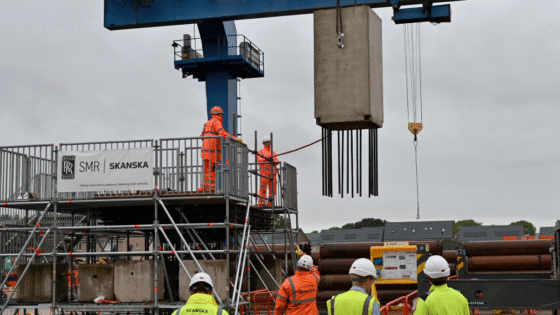
Skanska has built and tested a full-scale prototype reinforced concrete pedestal for Rolls-Royce’s small modular reactor (SMR) power plant, a key civil component in the factory-built station concept. The trial focused on constructability, tolerances and repeatability of the pedestal unit under off-site manufacturing conditions, using nuclear-grade concrete mix design and heavy reinforcement detailing. Results will inform final pedestal geometry, reinforcement congestion limits and lifting/transport interfaces, directly affecting foundation design, modularisation strategy and on-site assembly sequencing for future SMR projects.
Technical Brief
- Prototype pedestal forms part of Rolls-Royce’s factory-built SMR station concept rather than conventional in-situ nuclear civils.
- Skanska’s trial piece is intended to de-risk repeatable off-site manufacture for multiple identical reactor units.
- Component testing was carried out before any deployment to an operational SMR site or nuclear-licensed location.
- Lessons from the prototype will feed into Rolls-Royce’s standardised SMR civil works package for future projects.
- Interface detailing is being refined to integrate the pedestal with other modular nuclear island components.
- Outcomes are expected to influence construction sequencing and craneage planning for SMR installation campaigns.
- Skanska’s involvement signals Tier 1 contractor engagement in nuclear-grade off-site construction for SMRs.
Our Take
Skanska’s work on the Rolls‑Royce small modular reactor (SMR) prototype sits alongside its heavy civil roles on HS2’s London tunnels and the A428 Black Cat junction, signalling that the contractor is positioning itself for complex, long‑duration infrastructure where repeatable, standardised components are valuable.
Within our 960 Infrastructure stories, Skanska appears frequently in standardisation‑driven programmes such as the NHS ‘Hospital 2.0’ framework, which suggests its SMR involvement is likely to focus on modular civil designs and delivery models that can be replicated across multiple reactor sites.
For Rolls‑Royce, tapping a tier‑one contractor like Skanska—already embedded in major UK public frameworks—could ease future SMR deployment by aligning nuclear civil works with procurement routes and delivery practices already familiar to government clients.
Prepared by collating external sources, AI-assisted tools, and Geomechanics.io’s proprietary mining database, then reviewed for technical accuracy & edited by our geotechnical team.
Related Articles


Related Industries & Products
Construction
Quality control software for construction companies with material testing, batch tracking, and compliance management.
Mining
Geotechnical software solutions for mining operations including CMRR analysis, hydrogeological testing, and data management.
QCDB-io
Comprehensive quality control database for manufacturing, tunnelling, and civil construction with UCS testing, PSD analysis, and grout mix design management.