Geomechanics.io

  • Free Tools
Sign UpLog In
Built byBoxcut Studio

Geomechanics.io

Geomechanics, Streamlined.

© 2026 Geomechanics.io. All rights reserved.

Geomechanics.io

CMRR-ioGEODB-ioHYDROGEO-ioQCDB-ioFree Tools & CalculatorsBlogLatest Industry News

Industries

MiningConstructionTunnelling

Company

Terms of UsePrivacy PolicyLinkedIn
    Projects

    Silver miners’ persistent supply gap: project pipeline and capex lens for engineers

    November 25, 2026|

    Reviewed by Joe Ashwell

    Silver miners’ persistent supply gap: project pipeline and capex lens for engineers

    First reported on MINING.com

    30 Second Briefing

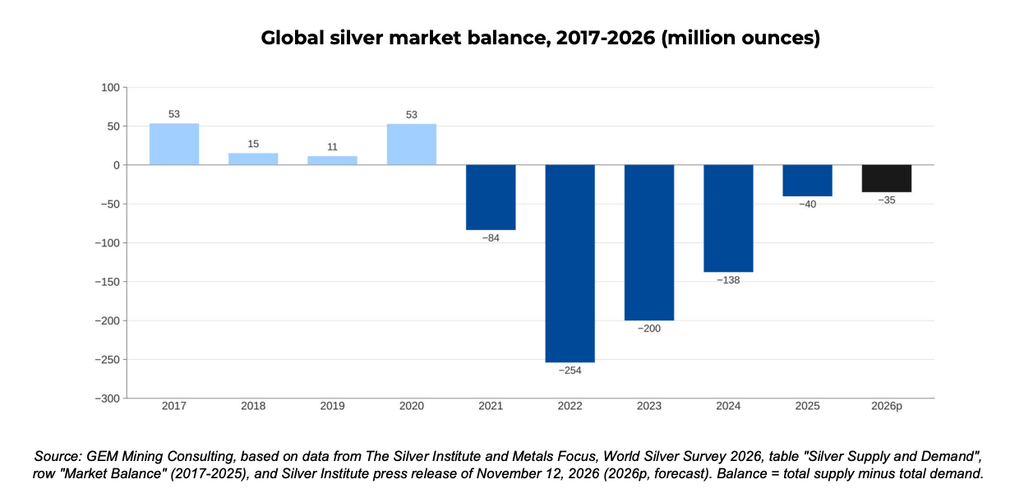
    Global silver mine production is forecast at about 834 million oz. in 2026, yet demand is still expected to exceed supply by 35 million oz., taking the cumulative deficit since 2021 to roughly 746 million oz., even as prices briefly topped $120/oz in January. Primary silver mines supplied only 26.1% of global output in 2025, with 29.4% coming from lead-zinc, 28% from copper and 15.9% from gold operations, limiting any direct production response to higher prices. Deutsche Bank expects solar-sector silver use to fall over 20% this year, London vault inventories of freely available metal to have risen 70% since October 2025, and spot prices to average around $70/oz by Q2 2027, complicating new project decisions.

    Technical Brief

    • Primary silver mines’ share of global supply fell to 26.1% in 2025, from 28.7% in 2019.
    • Lead–zinc operations supplied 29.4% of mined silver in 2025, copper 28%, and gold mines 15.9%.
    • Silver output from copper mines rose 24.5% between 2019–2025, driven by global copper growth and Chilean ramp-ups.
    • Over the same 2019–2025 period, silver from lead–zinc mines fell 7.3%, while gold-related silver increased only 2%.
    • Chilean copper mines cut silver output by 10% despite a 95% real silver price increase since 2019.
    • Dedicated silver mines’ production declined 7.9% from 2019–2025, attributed to grade deterioration and operational issues.
    • Metals Focus expects primary mines to add just 6.5 Moz in 2026, mainly via operational improvements in Mexico.
    • Higher prices lifted primary producers’ margins 187% in H1, even with a 47% rise in AISC.
    • Recycling volumes are forecast to rise 6% in 2026, reaching their highest level since 2012.
    • London commercial vaults held 914 Moz in August, with >300 Moz freely available, up 70% since October 2025.

    Our Take

    With primary silver mines forecast to supply only about a quarter of global output by 2025 while copper, lead, zinc and gold operations make up the balance, project pipelines in Chile, Mexico and China will be driven more by base-metal economics than by silver prices, complicating any supply response to a sustained deficit.

    Newmont’s Peñasquito and its large copper–gold projects such as Red Chris, which feature in other recent coverage, illustrate how incremental silver tonnes will increasingly come from complex polymetallic block caves and open pits where mine plans are optimised around copper and gold, limiting flexibility to chase higher silver prices alone.

    Geotechnical Software for Modern Teams

    Centralise site data, logs, and lab results with GEODB-io, CMRR-io, and HYDROGEO-io.

    Cancel at any time.

    • Save and export unlimited calculations
    • Advanced data visualisation
    • Generate professional PDF reports
    • Cloud storage for all your projects

    Prepared by collating external sources, AI-assisted tools, and Geomechanics.io’s proprietary mining database, then reviewed for technical accuracy & edited by our geotechnical team.

    Related Articles

    KSM project support from Nisga’a, Tahltan: permitting risks and schedule notes for engineers
    Mining
    about 3 hours ago

    KSM project support from Nisga’a, Tahltan: permitting risks and schedule notes for engineers

    Nisga’a and Tahltan Nations have reaffirmed their support for Seabridge Gold’s massive KSM copper-gold project in northwestern British Columbia after a 19 November BC Supreme Court ruling sent the project’s “substantially started” designation back to the province. The court ordered the government to conduct “deep consultation” with the Tsetsaut Skii km Lax Ha Nation before confirming the status, a key condition for maintaining KSM’s environmental assessment certificate. The decision injects permitting uncertainty and potential schedule risk into one of Canada’s largest undeveloped mining projects.

    Tudor’s $2.3B Treaty Creek mine: project economics and design risks for engineers
    Mining
    about 3 hours ago

    Tudor’s $2.3B Treaty Creek mine: project economics and design risks for engineers

    Tudor Gold’s Goldstorm deposit at Treaty Creek in northwestern British Columbia carries a post-tax NPV of $2.3 billion on initial capex of $1.54 billion, with a 28-year mine plan producing 4.68 million oz. of gold at a 20% IRR from a 10,000 t/d mill. The plan relies on higher-grade underground zones, including 13.6 million inferred tonnes at 3.78 g/t Au and nearby Perfectstorm (e.g. 9 g/t over 9.5 m), to lift early output to about 202,300 oz. Au/y in years three to 12. A key risk is infrastructure overlap and tunnel-rights conflict with Seabridge Gold’s KSM project, which may force facility relocation or redesign pending provincial and court-driven tenure decisions.

    Copper price slide after Nvidia rout: market signals for mine planners
    Mining
    about 3 hours ago

    Copper price slide after Nvidia rout: market signals for mine planners

    Copper fell 3.5% on Comex to $5.437/lb ($11,985/t), 21% below its September record, as investors rotated out of commodities after the Nvidia-driven AI rout and traders diverted an estimated 30,000–100,000 t of US cathode to China. Yangshan premiums have surged from under $100/t to about $500/t and visible exchange stocks cover only two days’ consumption, yet financial selling dominates amid expectations of a further Fed rate rise and uncertainty over US refined copper tariffs. Smelter treatment charge talks for 2027 remain deeply negative, with Antofagasta reportedly near –$200/t versus Tongling around –$80/t, threatening Chinese smelter margins and raising the risk of concentrate processing cuts.

    Related Industries & Products

    Mining

    Geotechnical software solutions for mining operations including CMRR analysis, hydrogeological testing, and data management.

    CMRR-io

    Streamline coal mine roof stability assessments with our cloud-based CMRR software featuring automated calculations, multi-scenario analysis, and collaborative workflows.

    HYDROGEO-io

    Comprehensive hydrogeological testing platform for managing, analysing, and reporting on packer tests, lugeon values, and hydraulic conductivity assessments.

    GEODB-io

    Centralised geotechnical data management solution for storing, accessing, and analysing all your site investigation and material testing data.

    AllGeotechnicalInfrastructureHazardsEnvironmental