Geomechanics.io

  • Free Tools
Sign UpLog In

    Geomechanics.io

    Geomechanics, Streamlined.

    © 2026 Geomechanics.io. All rights reserved.

    Geomechanics.io

    CMRR-ioGEODB-ioHYDROGEO-ioQCDB-ioFree Tools & CalculatorsBlogLatest Industry News

    Industries

    MiningConstructionTunnelling

    Company

    Terms of UsePrivacy PolicyLinkedIn
    Standard/Guideline
    Sustainability

    Net Zero Carbon Building Standard: performance benchmarking explained for engineers

    May 14, 2026|

    Reviewed by Tom Sullivan

    Net Zero Carbon Building Standard: performance benchmarking explained for engineers

    First reported on The Construction Index

    30 Second Briefing

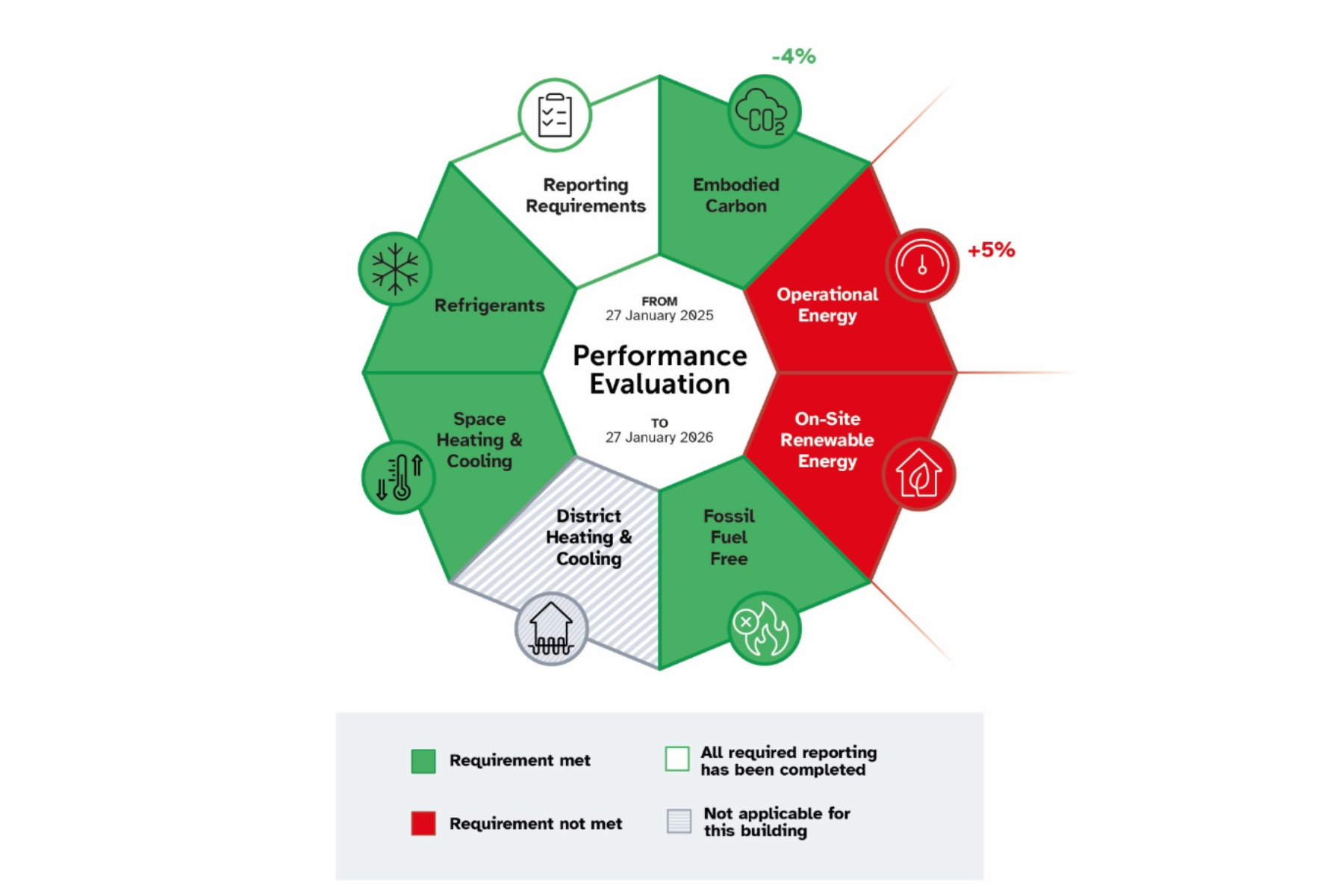
    A new performance evaluation under the Net Zero Carbon Building Standard now lets buildings that are not yet fully compliant benchmark operational and embodied carbon using the same metrics as aligned assets. The framework standardises reporting of whole-life carbon, enabling consistent comparison of energy use, material emissions and retrofit performance across mixed portfolios. For engineers, this supports more granular targeting of fabric upgrades, services optimisation and low‑carbon materials, while still working within existing design, occupancy and budget constraints.

    Technical Brief

    • Performance evaluation sits under the UK Net Zero Carbon Building Standard, aligning with its governance and definitions.
    • It applies to both operational and embodied carbon assessments across existing and new non‑domestic buildings.
    • Methodology is intended for use alongside established UK whole‑life carbon tools and benchmarks.
    • Framework is designed to integrate with existing asset surveys, energy audits and fabric condition assessments.
    • Evaluation supports staged decarbonisation plans, rather than requiring immediate full standard alignment.
    • Output metrics are structured to feed into capital planning, lifecycle costing and retrofit phasing.
    • Approach enables consistent reporting across mixed‑use portfolios, including varying ages, systems and occupancy patterns.
    • For other infrastructure assets, the structure suggests a template for harmonised carbon performance scoring systems.

    Our Take

    Because the Net Zero Carbon Building Standard is framed as a guideline rather than regulation, it is likely to be adopted first by institutional investors and large developers seeking to future-proof assets against later mandatory carbon caps, a pattern seen across other non-binding sustainability standards in our coverage.

    Geotechnical Software for Modern Teams

    Centralise site data, logs, and lab results with GEODB-io, CMRR-io, and HYDROGEO-io.

    No credit card required.

    • Save and export unlimited calculations
    • Advanced data visualisation
    • Generate professional PDF reports
    • Cloud storage for all your projects

    Prepared by collating external sources, AI-assisted tools, and Geomechanics.io’s proprietary mining database, then reviewed for technical accuracy & edited by our geotechnical team.

    Related Articles

    Canada’s mining industry reform push: project approvals and fiscal levers for engineers
    Policy
    about 19 hours ago

    Canada’s mining industry reform push: project approvals and fiscal levers for engineers

    Canada’s mining sector generated C$111 billion of GDP in 2024 and C$152 billion in mineral exports (21% of all merchandise exports), yet the Mining Association of Canada is warning that slow project approvals and uncompetitive fiscal terms are eroding the country’s position amid volatile, trade-restricted critical mineral markets. MAC is urging Ottawa to accelerate federal impact assessments and permitting, improve federal‑provincial coordination, and expand northern geoscience and resource assessments. It also wants broader Canadian Exploration Expense eligibility, tax credits for brownfield expansions, and rapid implementation of 2025 budget measures such as clean technology credits and accelerated capital cost allowances.

    Defra and Natural England newt review: design and licensing impacts for engineers
    Policy
    1 day ago

    Defra and Natural England newt review: design and licensing impacts for engineers

    Defra and Natural England have launched a call for evidence, open until 22 May 2026, asking developers and construction contractors to share practical experience of great crested newt protection on housing and infrastructure schemes. Supported by consultants LUC and ICF, the review targets on-site measures such as exclusion fencing, pitfall trapping, seasonal timing of earthworks and licensing delays. Responses could influence future mitigation licensing, survey requirements and design-stage constraints on sites where newt habitats intersect with foundations, drainage and earthworks.

    King’s Speech 2026: airport and infrastructure bills explained for engineers
    Policy
    1 day ago

    King’s Speech 2026: airport and infrastructure bills explained for engineers

    King Charles’s 2026 speech sets out bills aimed at unlocking UK airport expansion and accelerating major transport infrastructure construction. Measures are expected to streamline planning and consenting for runway extensions, terminal upgrades and associated surface access works, and to simplify approvals for large rail and highway schemes. Civil and geotechnical engineers should anticipate tighter programme windows, earlier ground investigation and design commitments, and greater emphasis on integrating airfield works with surrounding road and rail capacity upgrades.

    Related Industries & Products

    Construction

    Quality control software for construction companies with material testing, batch tracking, and compliance management.

    Mining

    Geotechnical software solutions for mining operations including CMRR analysis, hydrogeological testing, and data management.

    CMRR-io

    Streamline coal mine roof stability assessments with our cloud-based CMRR software featuring automated calculations, multi-scenario analysis, and collaborative workflows.

    HYDROGEO-io

    Comprehensive hydrogeological testing platform for managing, analysing, and reporting on packer tests, lugeon values, and hydraulic conductivity assessments.

    GEODB-io

    Centralised geotechnical data management solution for storing, accessing, and analysing all your site investigation and material testing data.

    AllGeotechnicalInfrastructureHazardsEnvironmental