National Highways’ Hertfordshire bridge infill: design and risk notes for engineers
Reviewed by Joe Ashwell
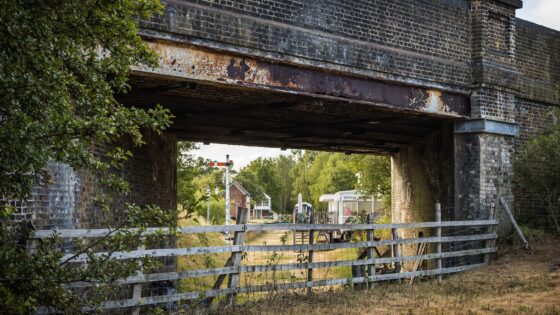
First reported on New Civil Engineer
30 Second Briefing
Campaigners have launched a petition against National Highways’ plan to infill a 125-year-old masonry railway bridge in Hertfordshire, attracting around 700 signatures in its first week and branding the works “vandalism”. The structure, part of the Historical Railways Estate, is reportedly earmarked for concrete or granular infill to remove the need for ongoing structural inspections and strengthening. Opponents argue that infilling will preclude future active travel or light rail reuse and want a repair-and-monitor regime instead of permanent burial of the arch barrel and abutments.
Technical Brief
- Proposed infill would convert the masonry arch into a buried culvert-like structure with minimal future access.
- Load paths would change from arch action to soil–structure interaction, relying on compacted backfill confinement.
- Any concrete infill would create a composite section, complicating future assessment of original masonry condition.
- Granular infill option introduces long-term settlement and drainage management requirements at the former trackbed.
- Once buried, installation of future service corridors or utilities through the span becomes significantly more complex.
- Infilling typically removes the need for intrusive examinations under current bridge inspection regimes, reducing access risk.
- For active travel reuse, later excavation of infill would require temporary works to stabilise abutments and spandrels.
Our Take
National Highways features heavily across recent infrastructure coverage, from the Lower Thames Crossing TBM selection to M3 Junction 9 upgrades, signalling that heritage disputes like this Hertfordshire bridge sit alongside a wider programme of major renewals and capacity schemes.
The closure of the North Bridge at M42 Junction 6 in another recent piece involving National Highways shows that safety-driven interventions on older structures are becoming more visible, which is likely to sharpen scrutiny of how the agency balances structural risk against heritage value on assets of similar age to this 125‑year‑old bridge.
With 2,416 tag‑matched ‘Projects’ items in our database, heritage-sensitive bridge works such as this are a small but high-profile subset, often generating stronger local mobilisation—as suggested by the early petition response—than routine motorway upgrades or viaduct renewals designed by partners like Jacobs.
Prepared by collating external sources, AI-assisted tools, and Geomechanics.io’s proprietary mining database, then reviewed for technical accuracy & edited by our geotechnical team.
Related Articles


Related Industries & Products
Mining
Geotechnical software solutions for mining operations including CMRR analysis, hydrogeological testing, and data management.
Construction
Quality control software for construction companies with material testing, batch tracking, and compliance management.
CMRR-io
Streamline coal mine roof stability assessments with our cloud-based CMRR software featuring automated calculations, multi-scenario analysis, and collaborative workflows.
HYDROGEO-io
Comprehensive hydrogeological testing platform for managing, analysing, and reporting on packer tests, lugeon values, and hydraulic conductivity assessments.
GEODB-io
Centralised geotechnical data management solution for storing, accessing, and analysing all your site investigation and material testing data.