M80 Ring Road Completion gantry: traffic loading and design notes for engineers
Reviewed by Joe Ashwell
First reported on Roads & Infrastructure (AU)
30 Second Briefing
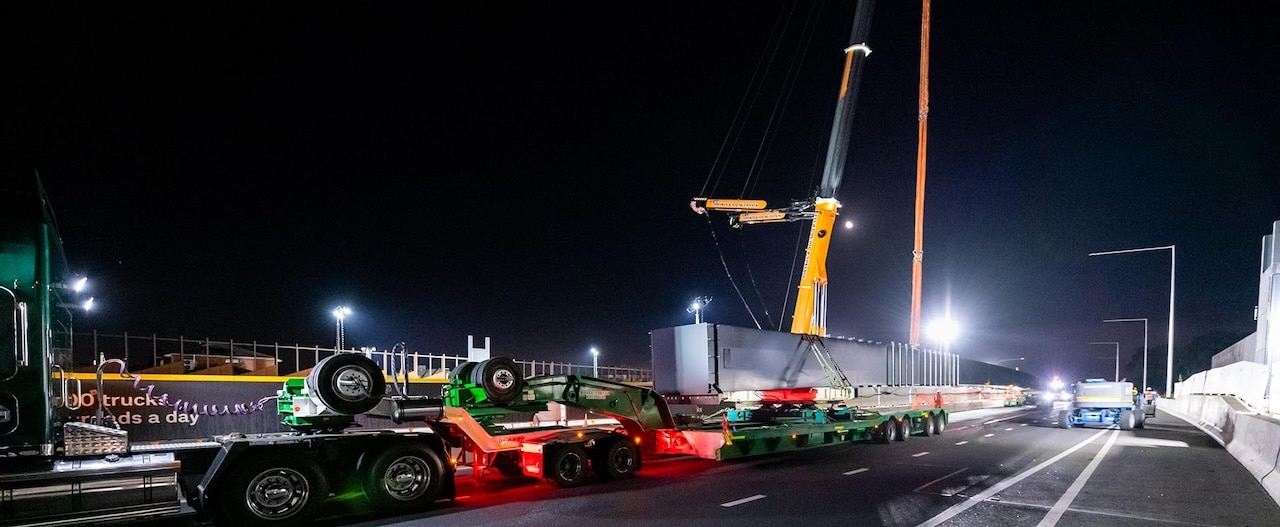
A nearly 100-tonne steel overhead gantry has been lifted into place on Melbourne’s M80 Ring Road as part of the $3.8 billion M80 Ring Road Completion project linking to the new North East Link tunnels. The structure will carry smart motorway equipment and lane control signage for the upgraded carriageways, which include additional lanes and intelligent transport systems. Once complete, the corridor is expected to remove up to 15,000 cars per day from local roads, changing traffic loading patterns on adjacent arterial and residential networks.
Technical Brief
- Nearly 100-tonne fabricated steel gantry demands substantial foundation design for uplift, fatigue and impact loads.
- Overhead structure is configured to support concentrated loads from smart motorway cabinets, cabling and lane-control sign panels.
- Installation over live carriageways implies staged night works, heavy-lift cranes and temporary traffic management barriers.
- Connection detailing must accommodate thermal expansion of the long-span steel frame above multi-lane pavement.
- Smart technology integration requires continuous power, fibre conduits and maintenance access built into the gantry layout.
- Additional lanes and overhead equipment will alter wind loading and buffeting patterns on the gantry and supports.
- Similar urban motorway upgrades often trigger re‑assessment of pavement design lives under redistributed heavy-vehicle traffic.
Our Take
The M80 Ring Road Completion in Melbourne sits alongside the Victorian Government’s intensive level crossing removal works at Macleod and Diggers Rest, signalling a coordinated push to untangle key road–rail conflict points on the city’s northern and western approaches.
A nearly 100‑tonne gantry on the M80 Ring Road will set a useful benchmark for constructability and traffic staging on other major Victorian corridors, particularly as North East Link tunnel interfaces will need similar heavy-lift and over-road installation strategies.
Within our 907 Infrastructure stories, Victoria features frequently for grade separations and freeway upgrades, suggesting that the A$3.8 billion M80 package is part of a sustained, multi-asset program rather than a one‑off capital burst, which has implications for contractor resourcing and long-term plant deployment in Melbourne.
Prepared by collating external sources, AI-assisted tools, and Geomechanics.io’s proprietary mining database, then reviewed for technical accuracy & edited by our geotechnical team.
Related Articles


Related Industries & Products
Construction
Quality control software for construction companies with material testing, batch tracking, and compliance management.
Tunnelling
Specialised solutions for tunnelling projects including grout mix design, hydrogeological analysis, and quality control.
CMRR-io
Streamline coal mine roof stability assessments with our cloud-based CMRR software featuring automated calculations, multi-scenario analysis, and collaborative workflows.
HYDROGEO-io
Comprehensive hydrogeological testing platform for managing, analysing, and reporting on packer tests, lugeon values, and hydraulic conductivity assessments.
GEODB-io
Centralised geotechnical data management solution for storing, accessing, and analysing all your site investigation and material testing data.