Kirk Hill bridge 14,000-brick milestone: design and staging notes for engineers
Reviewed by Tom Sullivan
First reported on New Civil Engineer
30 Second Briefing
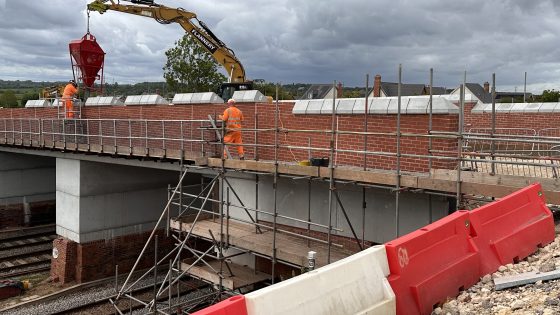
Crews have installed 14,000 bricks on the new Kirk Hill bridge at Sutton Bonington, Nottinghamshire, advancing construction of the replacement rail crossing on this section of line. The brickwork forms the architectural façade and parapets of the new bridge structure, which replaces an ageing asset that constrained clearances for modern rail operations. For geotechnical and civil teams, the milestone signals progression from primary structural works to envelope and finishing stages, with remaining tasks likely to focus on waterproofing, track alignment, and approach earthworks.
Technical Brief
- Installation of 14,000 facing bricks implies substantial masonry parapet length and multiple brickwork lifts.
- Brickwork will act as a non-structural façade, likely tied back to a concrete or steel deck.
- Sequencing bricklaying after primary bridge construction reduces risk of impact damage from heavy plant.
- Masonry detailing will need movement joints and weep holes to manage thermal and moisture behaviour.
- Brick parapets must satisfy current rail containment and anti-climb requirements, influencing height and coping design.
Our Take
Kirk Hill bridge adds to the 846 Infrastructure stories in our database, but relatively few of those focus on small-span brick structures in regional UK settings like Nottinghamshire, so this offers a useful benchmark for traditional masonry detailing and delivery rates.
With 14,000 bricks laid, the bridge sits at the upper end of what our coverage shows for decorative or facing masonry on local road bridges, suggesting the client has prioritised visual integration and durability over a purely utilitarian concrete solution.
New Civil Engineer’s parallel focus on BIM and digital handover in recent webinars indicates that even a conventionally built asset like Kirk Hill bridge in Sutton Bonington is likely to be captured in a more data-rich asset register than earlier generations of similar local bridges.
Prepared by collating external sources, AI-assisted tools, and Geomechanics.io’s proprietary mining database, then reviewed for technical accuracy & edited by our geotechnical team.
Related Articles


Related Industries & Products
Construction
Quality control software for construction companies with material testing, batch tracking, and compliance management.
Mining
Geotechnical software solutions for mining operations including CMRR analysis, hydrogeological testing, and data management.
QCDB-io
Comprehensive quality control database for manufacturing, tunnelling, and civil construction with UCS testing, PSD analysis, and grout mix design management.