HS2’s final Euston Tunnel TBM drive: design and risk notes for tunnelling engineers
Reviewed by Tom Sullivan
First reported on New Civil Engineer
30 Second Briefing
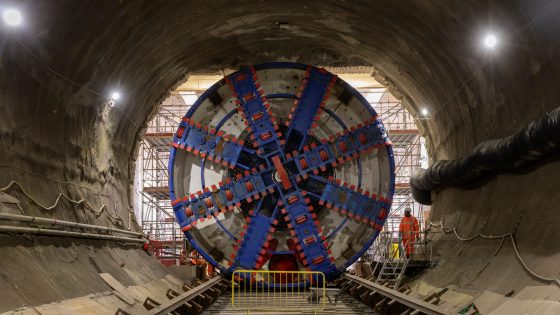
HS2’s tunnelling programme in London has entered its final phase as the 11th and last tunnel boring machine launches from Old Oak Common to drive the second 7.2km bore of the Euston Tunnel towards central London. The TBM will complete the twin-bore connection between Old Oak Common and Euston station, a key approach section for high-speed services entering the capital. For geotechnical and tunnelling teams, this marks the transition from multiple concurrent drives to a single remaining long urban drive beneath densely built central London ground conditions.
Technical Brief
- Launch shaft at Old Oak Common constrains TBM assembly, segment logistics and spoil handling in tight rail corridor.
- The Euston Tunnel drive passes beneath dense utilities and existing rail assets, tightening settlement and vibration criteria.
- London Clay and Lambeth Group sequences demand continuous face pressure control and real-time ground conditioning adjustments.
- Segmental lining design must accommodate high-speed rail kinematic envelope, aerodynamic loads and strict SLS deformation limits.
- Interface with future Euston station box requires millimetre-level breakthrough tolerances to align cross-passages and platform tunnels.
- Urban drive length forces high reliability of slurry treatment, backup systems and shift patterns to avoid prolonged stoppages.
- Tunnelling schedule is now dominated by a single long urban drive, concentrating risk into one TBM production stream.
- Lessons on settlement control and asset protection from earlier HS2 London drives will directly inform monitoring trigger levels here.
Our Take
With 11 TBMs now deployed across HS2, the Euston Tunnel drive in London sits alongside complex works like Curzon Street’s deep foundations and the Saltley Viaduct replacement in Birmingham, underscoring how HS2 is simultaneously managing multiple high‑risk underground and structural interfaces in dense urban environments.
Our database shows HS2 recurring across a large share of recent UK Infrastructure coverage, signalling that the project is currently one of the main drivers of specialist techniques in the sector, from CFA‑bored piling at Curzon Street to novel crane safety systems at Old Oak Common.
The 7.2 km Euston Tunnel adds to a growing portfolio of long, mechanised drives on HS2, which is likely to consolidate contractor and supply‑chain expertise in large‑diameter urban tunnelling that can be redeployed on future UK rail and utilities projects in London and other cities.
Prepared by collating external sources, AI-assisted tools, and Geomechanics.io’s proprietary mining database, then reviewed for technical accuracy & edited by our geotechnical team.
Related Articles


Related Industries & Products
Tunnelling
Specialised solutions for tunnelling projects including grout mix design, hydrogeological analysis, and quality control.
Mining
Geotechnical software solutions for mining operations including CMRR analysis, hydrogeological testing, and data management.
QCDB-io
Comprehensive quality control database for manufacturing, tunnelling, and civil construction with UCS testing, PSD analysis, and grout mix design management.