Hinkley Point C second reactor lift: heavy-lift lessons for project engineers
Reviewed by Tom Sullivan
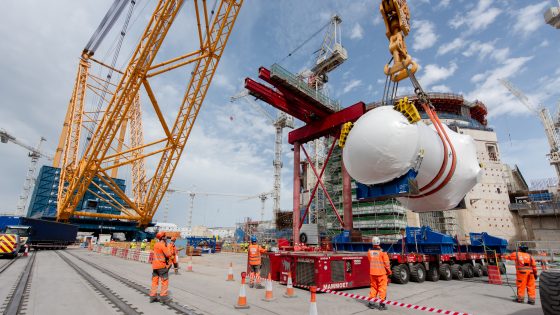
First reported on New Civil Engineer
30 Second Briefing
A 2‑day heavy-lift operation at Hinkley Point C has installed the second nuclear reactor using “Big Carl”, the world’s largest land-based crane. The lift involved precision placement of the reactor vessel into the reinforced concrete containment structure, integrating with pre-installed civil works and embedded systems. The operation confirms the site’s ability to execute ultra-heavy modular lifts, reducing on-site assembly time and driving tighter tolerances for future nuclear civil engineering packages.
Technical Brief
- Big Carl’s ring crane configuration allows full 360° slewing without relocating the base during the lift.
- The 2‑day operation required continuous crane stability checks against real‑time wind and load‑moment limits.
- Lift planning had to integrate with the reinforced concrete containment’s tolerances for embed plates and penetrations.
- Civil teams pre‑sequenced reinforcement congestion and anchor layouts to maintain crane clearance and hook access.
- Heavy-lift logistics included controlled exclusion zones over existing nuclear civil works and temporary works platforms.
- Interface management between mechanical, nuclear island civils and lifting contractor was critical to avoid rework on embedded systems.
Our Take
For practitioners following New Civil Engineer’s wider coverage of digital delivery and handover, such as its recent BIM and asset information webinar, this kind of tightly choreographed lift at Hinkley Point C underlines why construction sequencing and crane-time windows need to be explicitly modelled in 4D and asset data environments.
The use of the world’s largest crane at Hinkley Point C signals that future UK nuclear or large industrial projects may need to factor in early contracting and mobilisation of ultra-heavy lift capacity, as availability windows for such specialist kit can constrain programme options more than conventional plant.
Prepared by collating external sources, AI-assisted tools, and Geomechanics.io’s proprietary mining database, then reviewed for technical accuracy & edited by our geotechnical team.
Related Articles


Related Industries & Products
Construction
Quality control software for construction companies with material testing, batch tracking, and compliance management.
Mining
Geotechnical software solutions for mining operations including CMRR analysis, hydrogeological testing, and data management.
QCDB-io
Comprehensive quality control database for manufacturing, tunnelling, and civil construction with UCS testing, PSD analysis, and grout mix design management.