First Quantum’s Cobre Panamá halt: $3.5bn impact and project economics for engineers
Reviewed by Tom Sullivan
First reported on MINING.com
30 Second Briefing
Suspension of First Quantum’s Cobre Panamá copper mine has cost Panama an estimated $3.5 billion in forgone economic contribution over 2024–25, including about $1.1 billion in lost taxes and royalties, underlining the fiscal impact of keeping one of the world’s largest copper operations in preservation mode. First Quantum’s 2025 tax transparency report shows the mine would have added at least $1.8 billion to Panama’s 2025 economy alone, with more than $600 million in government revenue, over $250 million in wages and nearly $930 million in local procurement. Despite the shutdown, preservation activities and export of 122,520 dmt of stockpiled concentrate in 2025 still supported more than 1,700 workers, $107 million in local procurement and roughly $30 million in royalty payments while the company seeks a “durable resolution” with the government.
Technical Brief
- Cobre Panamá shipped 122,520 dmt of pre-mined copper concentrate in 2025 under export approval.
- Those concentrate exports generated about $312 million in proceeds while the mine remained in preservation mode.
- Roughly $30 million in royalties were still paid to Panama in 2025 from stockpile sales.
- Preservation and safe management activities retained more than 1,700 employees and contractors on site in 2025.
- Local procurement linked to preservation and export activities totalled approximately $107 million during 2025.
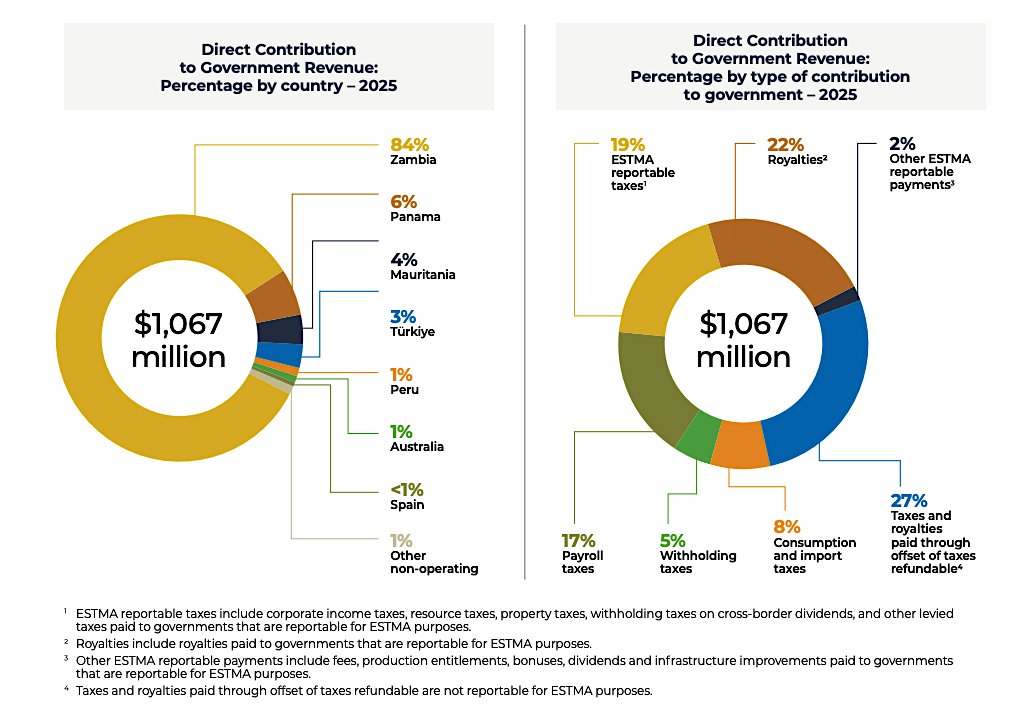
- First Quantum’s direct contributions to governments across all jurisdictions reached $4.1 billion in 2025 alone.
- Over the last eight years, the company reports cumulative direct government contributions of $9.6 billion.
- Zambia accounted for $3.5 billion of First Quantum’s 2025 economic contribution, dwarfing other jurisdictions that year.
Our Take
The Cobre Panamá shutdown sits alongside weaker copper output at First Quantum’s Zambian Sentinel and Kansanshi mines reported in Q1 2026, suggesting the company’s copper portfolio is under simultaneous volume and jurisdictional pressure across Panama and Zambia.
Panama’s estimated forgone taxes and royalties of about $1.1 billion from Cobre Panamá contrasts with Zambia’s $3.5 billion economic contribution from First Quantum last year, which may give Lusaka additional leverage in fiscal and permitting negotiations relative to Panama.
The presence of both copper and LNG in this piece, via Cobre Panamá and the $12.5 billion Commonwealth LNG project backed by Caturus, reflects a small subset of our mining coverage where upstream metals exposure is paired with large-scale US energy infrastructure, a combination that can diversify country risk but complicates capital allocation timing.
Prepared by collating external sources, AI-assisted tools, and Geomechanics.io’s proprietary mining database, then reviewed for technical accuracy & edited by our geotechnical team.
Related Articles

Related Industries & Products
Mining
Geotechnical software solutions for mining operations including CMRR analysis, hydrogeological testing, and data management.
Construction
Quality control software for construction companies with material testing, batch tracking, and compliance management.
CMRR-io
Streamline coal mine roof stability assessments with our cloud-based CMRR software featuring automated calculations, multi-scenario analysis, and collaborative workflows.
HYDROGEO-io
Comprehensive hydrogeological testing platform for managing, analysing, and reporting on packer tests, lugeon values, and hydraulic conductivity assessments.
GEODB-io
Centralised geotechnical data management solution for storing, accessing, and analysing all your site investigation and material testing data.