Fehmarnbelt immersed tunnel: delivery lessons and sequencing insights for engineers
Reviewed by Joe Ashwell
First reported on New Civil Engineer
30 Second Briefing
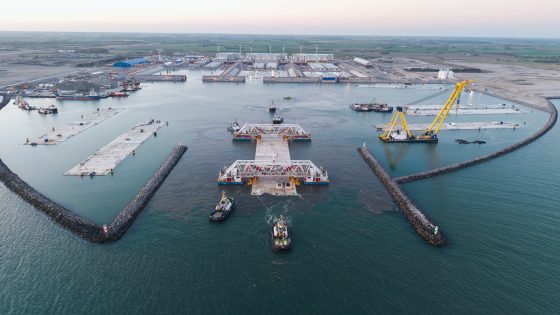
Immersion of the first of 89 tunnel elements for the Fehmarnbelt fixed link between Denmark and Germany was completed in May after a multi‑day marine operation, marking a key milestone for the 18km immersed tunnel. Project director Guy Taylor details how factory-style offsite production of standardised concrete elements and tightly sequenced immersion campaigns are being used to control programme and cost on what will be the world’s longest immersed road and rail tunnel.
Technical Brief
- Immersed element installation relied on a multi-day marine campaign with tightly controlled weather and current windows.
- Marine works required precision ballasting and positioning to millimetre tolerances to achieve gasket compression and watertightness.
- Construction sequencing was organised so immersion operations, dredging, and backfilling could run in overlapping work fronts.
- Offsite “factory” production demanded repeatable reinforcement cages, formwork systems and curing regimes to minimise variability between elements.
- Quality control focused on consistent concrete mix behaviour across all elements to avoid differential shrinkage at joints.
- Logistics planning integrated heavy-lift vessels, tugs and temporary moorings to handle the large precast units safely.
- Risk management centred on reducing weather-related downtime by clustering immersions into defined seasonal windows with contingency float.
Our Take
With 89 tunnel elements, the Fehmarnbelt tunnel sits at the extreme end of project scale in our 923-item Infrastructure database, making its delivery methods a reference point for other long linear assets discussed in New Civil Engineer’s BIM and digital handover webinars.
Given New Civil Engineer’s recurring coverage of early-career innovation challenges in bridges and airports, Fehmarnbelt’s segmented element approach offers a live case study for modularisation and offsite fabrication strategies that younger practitioners are being encouraged to adopt on future large-scale projects.
Prepared by collating external sources, AI-assisted tools, and Geomechanics.io’s proprietary mining database, then reviewed for technical accuracy & edited by our geotechnical team.
Related Articles


Related Industries & Products
Construction
Quality control software for construction companies with material testing, batch tracking, and compliance management.
Tunnelling
Specialised solutions for tunnelling projects including grout mix design, hydrogeological analysis, and quality control.
QCDB-io
Comprehensive quality control database for manufacturing, tunnelling, and civil construction with UCS testing, PSD analysis, and grout mix design management.