Canada’s $200B clean energy build‑out: approvals and grid risks for project teams
Reviewed by Tom Sullivan
First reported on MINING.com
30 Second Briefing
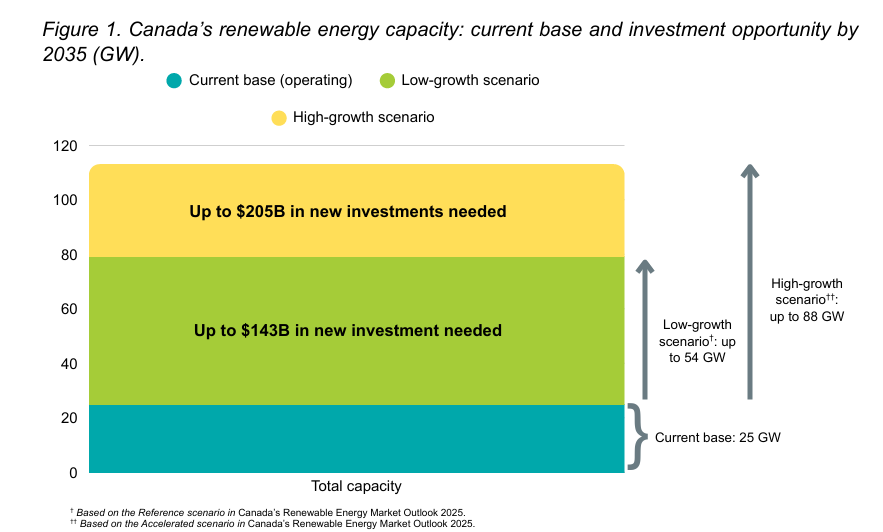
Canada could attract up to C$200 billion over 10 years to build 54–88 GW of new wind, solar and storage capacity—more than tripling its current ~25 GW—driven by industrial electrification, data centre growth and expanding mining and manufacturing loads, according to CanREA. The report warns that lengthening approvals, permitting and grid interconnection queues are now the main constraint, raising carrying costs and schedule risk for developers. China’s addition of 430 GW of renewables in 2025, backed by over US$600 billion in annual clean energy investment and parallel transmission and storage build-out, is cited as the benchmark for coordinated delivery.
Technical Brief
- CanREA identifies ~25 GW already operating and a further ~25 GW in development or procurement pipelines.
- Report pegs required capital at up to C$200 billion, equating to roughly C$20 billion per year.
- Authors state bottleneck is approvals, permitting and interconnection queues, not shortages of capital or technology.
- Lengthening approval timelines are explicitly raising project carrying costs and forcing reassessment of schedule‑risk premiums.
- Margin between demand growth and realistic delivery timelines is narrowing as electrification accelerates, increasing resource adequacy risk.
- China added >430 GW of renewables in 2025 alone, over half of global annual additions.
- Chinese build‑out is backed by >US$600 billion per year in clean energy investment plus parallel transmission and storage expansion.
- Canada’s 2025 additions were only 1.5 GW, underscoring a delivery gap versus China’s coordinated deployment model.
Our Take
The presence of rare earth and yttrium oxide in this Infrastructure piece links it to 119 keyword‑matched items in our database, signalling that grid‑scale renewables build‑out is increasingly being analysed alongside upstream critical mineral supply risk rather than as a pure power‑market issue.
China’s approval of a 60‑tonne yttrium oxide shipment, contrasted with Canada’s need for 54–88 GW of new capacity, underlines that Canadian project developers may face indirect exposure to Chinese export policies not just for PV modules and batteries but also for niche rare earth inputs into inverters, magnets and control systems.
Recent coverage of the Tanbreez heavy rare earth project and other rare earth M&A shows capital flowing into non‑Chinese supply, suggesting that if Canada accelerates permitting for wind, solar and storage, there will likely be parallel pressure to streamline approvals for domestic or allied‑jurisdiction rare earth projects feeding those supply chains.
Prepared by collating external sources, AI-assisted tools, and Geomechanics.io’s proprietary mining database, then reviewed for technical accuracy & edited by our geotechnical team.
Related Articles


Related Industries & Products
Mining
Geotechnical software solutions for mining operations including CMRR analysis, hydrogeological testing, and data management.
Construction
Quality control software for construction companies with material testing, batch tracking, and compliance management.
CMRR-io
Streamline coal mine roof stability assessments with our cloud-based CMRR software featuring automated calculations, multi-scenario analysis, and collaborative workflows.
QCDB-io
Comprehensive quality control database for manufacturing, tunnelling, and civil construction with UCS testing, PSD analysis, and grout mix design management.
HYDROGEO-io
Comprehensive hydrogeological testing platform for managing, analysing, and reporting on packer tests, lugeon values, and hydraulic conductivity assessments.