Bolivia unrest and lithium assets: project risk and schedule impacts for mine planners
Reviewed by Joe Ashwell
First reported on MINING.com
30 Second Briefing
Bolivian President Rodrigo Paz’s proposed “state of exception” law, following Law 1732 and 36 days of nationwide protests with more than 90 road blockades across eight regions, injects fresh political and security risk into development of the Salar de Uyuni and other world-class lithium resources. Expanded military powers to clear transport corridors for food, fuel and medical supplies raise the prospect of violent confrontation with peasant organisations, labour unions and the Bolivian Workers’ Union. For lithium developers, OEMs and battery makers, the standoff threatens timelines and investment appetite in one of the largest yet least-developed brine provinces.
Technical Brief
- Law 1732 removed post-2019 limits on military deployment during civic demonstrations, changing security-force rules of engagement.
- The proposed state of exception bill formally authorises joint military–police operations during “public unrest” events.
- Protests have run for 36 days, with >90 road blockades across eight regions disrupting logistics.
- Government justification centres on restoring bulk transport of food, fuel and medical supplies into La Paz and El Alto.
- Social organisations warn the bill grants legal cover for forced clearance of roadblocks and crowd dispersal.
- US Secretary of Defence Pete Hegseth publicly framed the protests as an attempted coup and backed Paz’s government.
- Former president Evo Morales alleges new defence minister Ernesto Justiniano visited Washington shortly before his appointment.
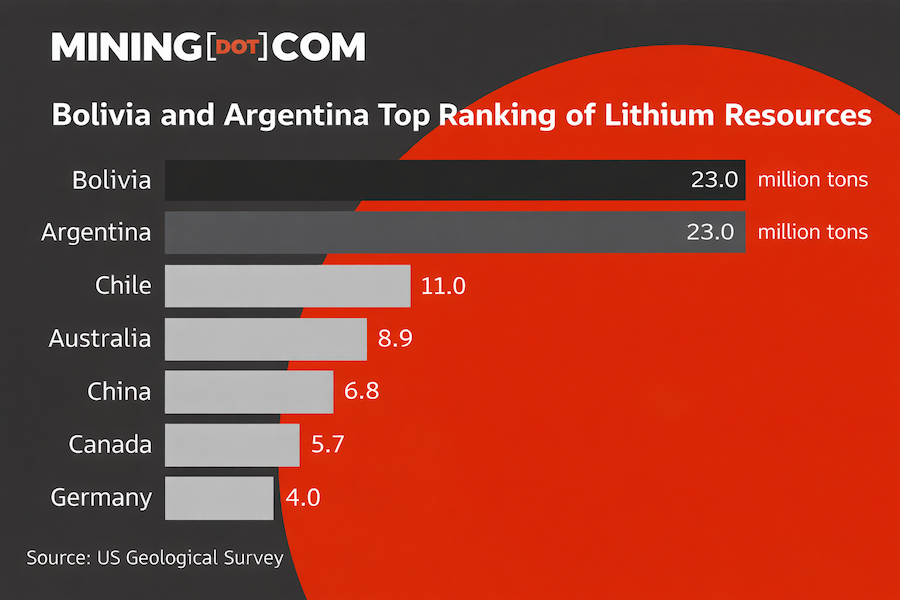
- Bolivia’s lithium development lag versus Argentina and Chile is attributed to investor caution over regulatory and social instability.
Our Take
The Department of War’s appearance in both this Bolivia-focused piece and multiple related items (Lattice Materials’ Montana plant, Lynas Rare Earths’ LOI, MP Materials–Maaden JV) signals that US defence-linked agencies are rapidly building alternative lithium and rare earth supply chains that could bypass politically unstable jurisdictions like Bolivia.
With lithium and broader critical minerals as shared keywords across 216 matched pieces in our database, the instability around Salar de Uyuni stands out as one of the few major upstream risks in Latin America at a time when most other recent coverage has centred on US- or allied-country processing and refining capacity.
Prepared by collating external sources, AI-assisted tools, and Geomechanics.io’s proprietary mining database, then reviewed for technical accuracy & edited by our geotechnical team.
Related Articles
Related Industries & Products
Mining
Geotechnical software solutions for mining operations including CMRR analysis, hydrogeological testing, and data management.
Construction
Quality control software for construction companies with material testing, batch tracking, and compliance management.
CMRR-io
Streamline coal mine roof stability assessments with our cloud-based CMRR software featuring automated calculations, multi-scenario analysis, and collaborative workflows.
HYDROGEO-io
Comprehensive hydrogeological testing platform for managing, analysing, and reporting on packer tests, lugeon values, and hydraulic conductivity assessments.
GEODB-io
Centralised geotechnical data management solution for storing, accessing, and analysing all your site investigation and material testing data.