America’s mineral awakening: supply chain risks and project cues for engineers
Reviewed by Tom Sullivan
First reported on MINING.com
30 Second Briefing
America’s rapid “mineral awakening”, argued by Brian Paes‑Braga, CEO of The Metals Royalty Company (Nasdaq: TMCR), is driven by dependence on foreign processing, with China now handling roughly 70% of global energy‑related critical minerals and 98% of primary gallium. The US was fully import‑dependent for 16 non‑fuel minerals in 2025, while an F‑35 needs about 900 lb of rare earths and a hyperscale AI data centre can require up to 50,000 tonnes of copper, exposing defence and grid resilience to external chokepoints.
Technical Brief
- Between 2001–2010, the US–China trade deficit displaced 2.8 million US jobs, including 1.9 million manufacturing roles.
- China now dominates processing for 19 of 20 energy‑related critical minerals, averaging ~70% market share.
- Concentration is extreme for some inputs: 98% of primary gallium and >90% of battery‑grade graphite processing.
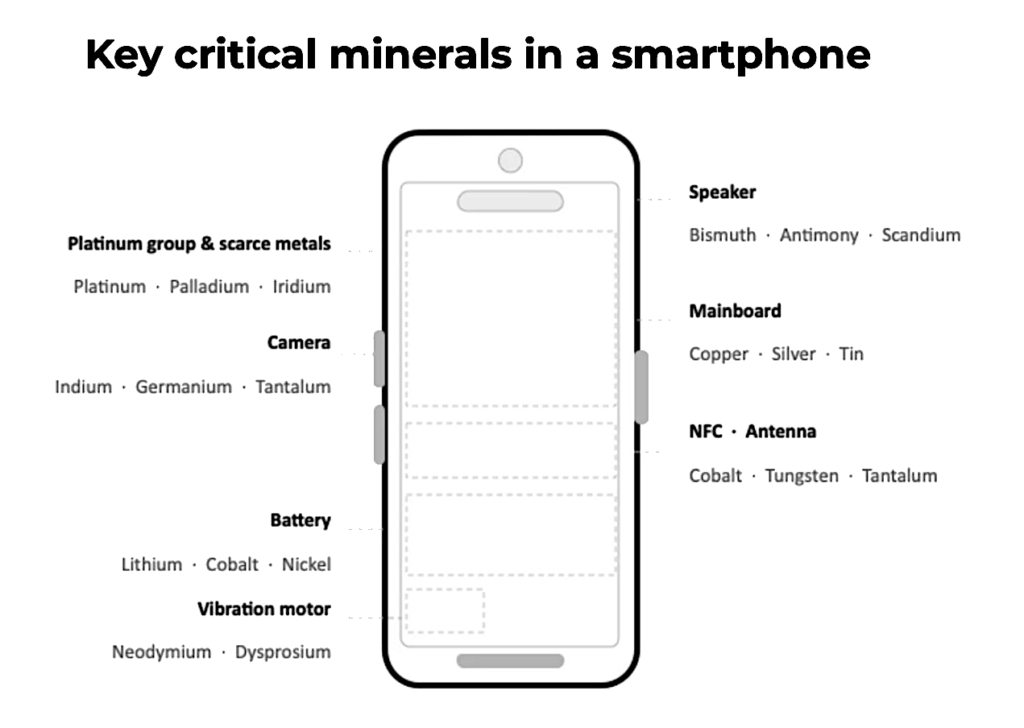
- A conventional vehicle uses ~35 kg of critical minerals, versus ~200 kg for an electric vehicle.
- US forces in Operation Epic Fury expended >5,000 munitions in 96 hours across 35 weapon types.
- Replacing those 96‑hour munitions needs ~92 t copper, 137 kg neodymium, 18 kg gallium and 37 kg tantalum.
- Large data centres typically require 5,000–15,000 tonnes of copper; hyperscale AI facilities can reach ~50,000 tonnes.
- In 1950, the US produced 47% of global steel, with the Pittsburgh–Detroit–Chicago belt as the industrial core.
- China’s strategy has focused on acquiring mines, ports, processing plants and offtake across Africa, South America, SE Asia and the Middle East.
Our Take
The emphasis on US dependence for critical minerals such as gallium, graphite and rare earths lines up with new financial products like Sprott’s Rare Earths Ex-China ETF on Nasdaq, which is explicitly designed to channel capital into non-Chinese supply chains for these same materials.
The Metals Royalty Company’s recent Nasdaq listing, tied to polymetallic nodules rich in nickel, cobalt and copper, shows that US-facing capital markets are already backing unconventional offshore sources of the very battery metals this op-ed flags as strategic vulnerabilities for the United States.
Across our mining coverage, most US-focused critical minerals pieces now involve Nasdaq-linked vehicles (HiTech Minerals/US Elemental, Deep Sea Minerals, Sprott’s REXC), suggesting that onshoring ambitions for lithium, nickel, cobalt and rare earths are increasingly being pursued via US equity-market structures rather than solely through traditional project finance.
Prepared by collating external sources, AI-assisted tools, and Geomechanics.io’s proprietary mining database, then reviewed for technical accuracy & edited by our geotechnical team.
Related Articles


Related Industries & Products
Mining
Geotechnical software solutions for mining operations including CMRR analysis, hydrogeological testing, and data management.
Construction
Quality control software for construction companies with material testing, batch tracking, and compliance management.
CMRR-io
Streamline coal mine roof stability assessments with our cloud-based CMRR software featuring automated calculations, multi-scenario analysis, and collaborative workflows.
QCDB-io
Comprehensive quality control database for manufacturing, tunnelling, and civil construction with UCS testing, PSD analysis, and grout mix design management.
HYDROGEO-io
Comprehensive hydrogeological testing platform for managing, analysing, and reporting on packer tests, lugeon values, and hydraulic conductivity assessments.