AASHTO/ASTM vs Eurocode for SuDS tanks: design lessons for drainage engineers
Reviewed by Joe Ashwell
First reported on New Civil Engineer
30 Second Briefing
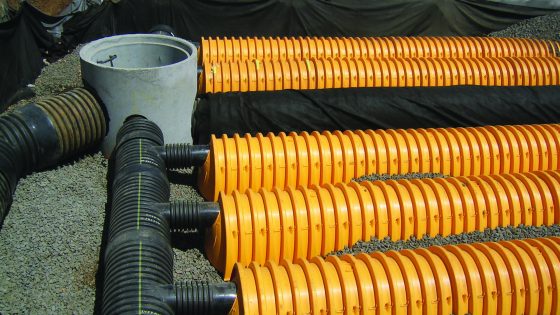
Growing deployment of subsurface stormwater tanks and pipes in SuDS schemes is putting thermoplastic structural design under scrutiny, as Stuart Crisp, UK manager at Advanced Drainage Systems (ADS), contrasts North American AASHTO LRFD / ASTM approaches with Eurocode-based practice. He notes that AASHTO/ASTM methods explicitly integrate long-term creep, installation quality and soil–structure interaction for buried HDPE and PP chambers, whereas Eurocode design often relies on traditional rigid pipe assumptions. The comparison signals a need for clearer Eurocode-aligned guidance on ring stiffness, deflection limits and verification of large modular attenuation systems.
Technical Brief
- Design discussion centres on subsurface SuDS installations subject to traffic loading and shallow cover constraints.
- Installation quality is treated as a structural variable, with trench width, compaction level and embedment class explicitly considered.
- Soil–structure interaction is addressed via composite stiffness of pipe plus embedment, not pipe ring stiffness alone.
- He notes that current European practice often extrapolates rigid pipe bedding diagrams to flexible thermoplastic chambers.
- Implication for SuDS schemes: designers may need project-specific verification of large plastic tanks beyond catalogue ring stiffness.
Our Take
Advanced Drainage Systems (ADS) and Stuart Crisp already feature in several New Civil Engineer op-eds in our database focused on SuDS performance and regulatory gaps, so this AASHTO/ASTM vs Eurocode comparison is likely part of a broader push to influence how UK drainage design is standardised and approved.
Prepared by collating external sources, AI-assisted tools, and Geomechanics.io’s proprietary mining database, then reviewed for technical accuracy & edited by our geotechnical team.
Related Articles


Related Industries & Products
Construction
Quality control software for construction companies with material testing, batch tracking, and compliance management.
CMRR-io
Streamline coal mine roof stability assessments with our cloud-based CMRR software featuring automated calculations, multi-scenario analysis, and collaborative workflows.
HYDROGEO-io
Comprehensive hydrogeological testing platform for managing, analysing, and reporting on packer tests, lugeon values, and hydraulic conductivity assessments.
GEODB-io
Centralised geotechnical data management solution for storing, accessing, and analysing all your site investigation and material testing data.